
EACS Case Study
Case Study
From 10,000 printed booklets to guidelines at the bedside.
How the European AIDS Clinical Society uses GuidelineHQ to deliver evidence-based HIV treatment and comorbidity guidance to clinicians across Europe and beyond.
The Challenge
Guidelines that were obsolete the moment they were printed.
The European AIDS Clinical Society publishes clinical practice guidelines for the treatment and management of people living with HIV. Covering antiretroviral therapy, drug interactions, and a substantial body of comorbidity guidance, the EACS Guidelines are referenced by the European Centre for Disease Prevention and Control (ECDC) and the World Health Organization (WHO), and are used as national guidelines in several countries.
Before 2012, EACS distributed these guidelines one way: as printed booklets, small enough to fit in a clinician's lab coat pocket, handed out at EACS conferences every two years or mailed to hospitals and clinics on request — 10,000 copies at a time.
The problem was immediate and unavoidable.
“When you print something, it's obsolete. You open it, see a mistake, and you cannot reprint.”
Joëlle VerluytenExecutive Director, European AIDS Clinical Society
But EACS did reprint. Archived versions — 6.1, 6.2 — document the cycle: print 10,000 copies, find an error in a dosage or recommendation, reprint. Each cycle carried cost, delay, and no guarantee the corrected version would reach the clinicians still carrying the outdated one.
As the guidelines grew — from a simple leaflet to a substantial booklet, with the comorbidity section expanding significantly over the years — the print model strained further. Editorial deadlines compressed against the October conference schedule. The review process grew heavier. And there was no way to know whether clinicians were actually using the guidelines once the booklets left the conference floor.
By the late 2000s, a PDF lived on the EACS website alongside the printed booklet. Three formats for the same guidelines, each with its own layout, each with its own update cycle.
“The layout was different for the website, for the PDF, and for the booklet. Nightmare.”
Joëlle VerluytenExecutive Director, European AIDS Clinical Society
The Implementation
Support that earned trust.
EACS is not a technology organization. Its guideline panels are composed entirely of clinicians — the chair, coordinators, and young scientists who review and update the evidence. They are experts in HIV treatment, not digital publishing.
Sanford Guide's support went beyond technical troubleshooting. They actively proposed solutions — suggesting how content should be structured, what would work in a mobile format, and what wouldn't. Crucially, they also knew when to push back.
“They show up with proposals — maybe you should do it this way or that way. And when it's not possible, they say no, that's not possible, I don't recommend it. That's really good.”
Joëlle VerluytenExecutive Director, European AIDS Clinical Society
In Joëlle's Words
“We had a lot of support because we work with clinicians — they're not tech savvy. The Sanford Guide team really helped with the support. And that was the most important, because we know we can rely on them.”
Joëlle VerluytenExecutive Director, European AIDS Clinical Society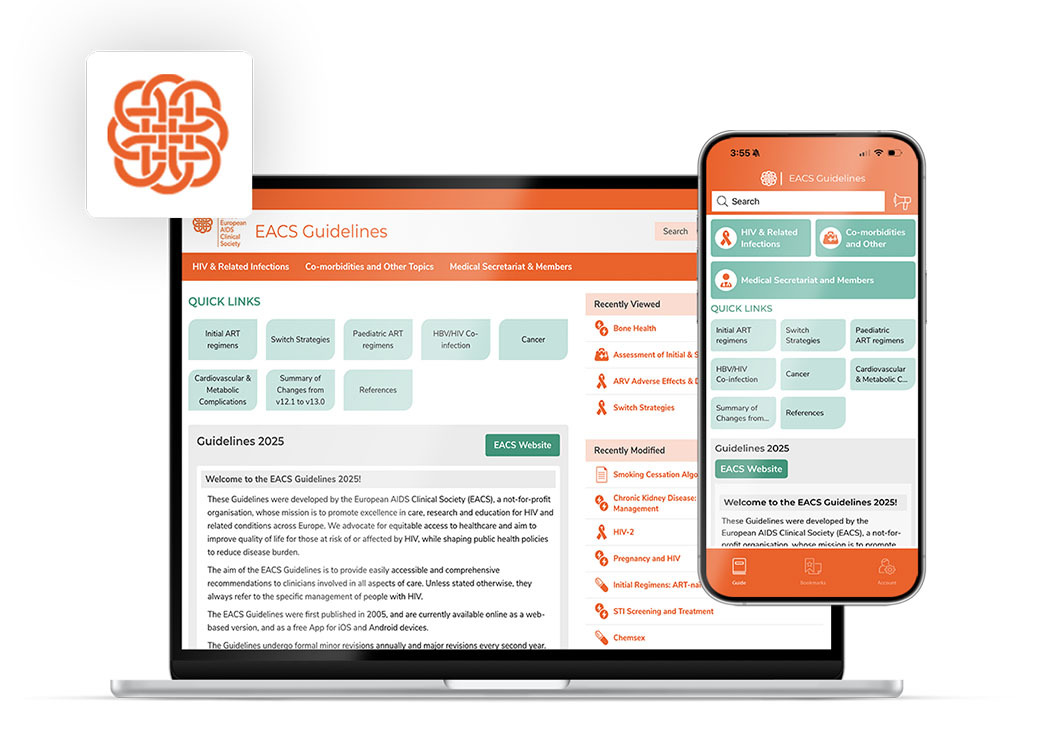
How It Works Today
Updates that go live the same day.
Today, EACS guidelines live on a fully EACS-branded app (iOS and Android) and website, powered by GuidelineHQ. The content is structured into two parts: Part 1 covers HIV treatment, and Part 2 covers comorbidities — a reorganization approved by the governing board in their most recent major update.
The editorial workflow reflects how a medical society actually operates. Young scientists and panel coordinators have direct writing access to the platform and can publish corrections or evidence updates immediately — no IT involvement, no app store approval cycle, no waiting for a reprint.
Major structural changes — like the recent Part 1 / Part 2 reorganization — still require governing board approval, typically introduced at the biennial EACS conference. But the cadence of routine updates has fundamentally changed.
“It's right away. Our authors have easy access, and they can go and make changes right away.”
Joëlle VerluytenExecutive Director, European AIDS Clinical Society
What's Next
From printed booklet to living platform.
EACS continues to evolve how its guidelines are structured and delivered. Recent improvements include a visual redesign for better readability on mobile devices and a move away from static table formats toward content structures optimized for phone and tablet screens.
The trajectory from 10,000 printed booklets to a continuously updated digital platform mirrors a broader shift in how clinical practice guidelines reach the people they're written for. For EACS, that shift took more than a decade of incremental decisions — each one moving closer to the goal that the printed booklet was originally designed to serve: authoritative guidance that fits in a clinician's pocket, available when it matters.
The difference is that now, when someone finds an error, it's fixed in minutes. Not reprinted by the thousands.
About GuidelineHQ
GuidelineHQ is a custom-branded guideline management platform from Sanford Guide (Antimicrobial Therapy, Inc.) — purpose-built for professional medical societies and health systems. The platform provides branded apps and websites, interactive clinical tools, editorial dashboards, push notifications, usage analytics, and white-glove content migration, backed by 15 years of guideline technology and 365-day technical support.
Bring your guidelines closer to clinicians.
Schedule a working conversation with our team. We'll walk through the platform, discuss your guideline portfolio, and put together a written proposal — typically within a week.